
Choosing labels for a commercial printer isn't simply a question of finding the right size.
What you're labelling, where the product will be used, how long the label needs to last and the conditions it will encounter can all determine which label material, adhesive and ribbon you need.
For thermal transfer printers, it's particularly important to consider the label and ribbon together. The right combination can produce a clear, durable label, while an unsuitable combination can result in poor print quality, smudging or labels that fail long before they should.
So, where should you start?
This is the most important question.
A label attached to a cardboard box in a dry warehouse has very different requirements from one attached to a bottle, chemical container or product stored in a freezer.
Boxes, packaging and shipping
Paper labels are commonly suitable for cardboard boxes, shipping cartons and general warehouse applications.
If the label only needs to survive storage and distribution in relatively controlled conditions, there may be little benefit in specifying a more expensive synthetic material.
Bottles, jars and containers
Labelling bottles introduces different considerations.
Will the surface be glass or plastic? Is it curved? Could the label become wet? Will the container be refrigerated? Could oils, chemicals or cleaning products come into contact with it?
The label material and adhesive both need to be suitable for the surface and environment.
Manufacturing and components
Labels used to identify manufactured components may need to remain readable throughout production, storage and the subsequent life of the product.
Depending on the application, resistance to abrasion, heat, oils or chemicals could be important.
A durable synthetic label combined with an appropriate thermal transfer ribbon may therefore be required.
Food and pharmaceuticals
Labels used within food, pharmaceutical and healthcare environments can have much more specific requirements.
Traceability, batch information, dates, storage conditions and reliable barcode scanning can all be important.
There may also be regulatory requirements governing the information displayed and the materials used in particular applications.
In these environments, label selection should form part of the wider compliance requirements rather than being treated purely as a printing decision.
It's easy to choose a label based on how it looks when it leaves the printer.
The more important question is: what happens to it afterwards?
Consider whether the finished label will encounter:
A standard paper label may be perfectly suitable in a clean, dry warehouse but completely inappropriate for equipment being used outdoors.
There's little point producing a beautifully printed label if it becomes unreadable halfway through its required working life.
There are many specialist materials available, but most applications broadly fall into paper or synthetic labels.
Paper labels provide an economical solution for many general-purpose applications including shipping, packaging, retail and warehousing.
Synthetic labels, including materials such as polypropylene and polyester, can provide greater resistance to moisture, tearing, abrasion and challenging environmental conditions.
The more durable material will normally cost more, so there's no benefit in automatically specifying the toughest label available.
The objective is to choose a material durable enough for the application without unnecessarily over-specifying it.
Choosing the label material is only half the job. It also needs to remain attached to whatever you're labelling.
Different adhesives are designed for different applications.
A label might need to stick permanently to cardboard, adhere to curved plastic, remain attached in a freezer or be deliberately removable without leaving residue.
The surface itself can also make a significant difference.
Smooth glass, textured cardboard, plastic and metal don't necessarily behave in the same way.
Before ordering large quantities of labels, it's sensible to test them on the actual product or packaging and under the conditions they'll encounter.
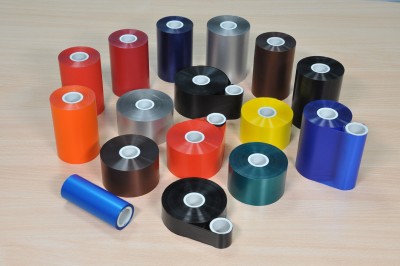
If you're using thermal transfer printing, the ribbon needs to be compatible with both the printer and label material.
Thermal transfer ribbons broadly fall into three categories.
Wax ribbons
Wax ribbons are commonly used with paper labels.
They're an economical option for general-purpose printing where the finished label won't encounter particularly demanding conditions.
Wax/resin ribbons
Wax/resin provides greater resistance to rubbing and scratching and can be used where more durability is required.
They provide a useful middle ground for applications where a standard wax ribbon isn't sufficiently robust.
Resin ribbons
Resin ribbons are designed for demanding applications and are commonly paired with suitable synthetic label materials.
They can provide high levels of resistance to moisture, abrasion and chemicals, depending on the particular combination of ribbon and label.
Again, the most expensive option isn't automatically the best.
Using a high-performance resin ribbon for a cardboard shipping label that will be discarded next week would probably be unnecessary.
Yes, but perhaps not in the way you might expect.
Printing more labels doesn't automatically mean you need a more durable label or ribbon. Durability is determined primarily by the application.
Volume does, however, make cost, roll capacity and efficiency increasingly important.
A small difference in cost per label might be insignificant when printing 500 labels a month but substantial when producing hundreds of thousands.
High-volume operations should consider:
For lower-volume applications, convenience and having the correct material available may be more important than achieving the lowest possible unit cost.
The objective shouldn't simply be to buy the cheapest consumables. It should be to find the most economical combination that reliably does the job.
Potentially, and this should be established before choosing the label.
Different industries can have specific requirements governing product identification, safety information, traceability, barcodes, batch numbers, expiry dates and the durability or legibility of labels.
Food, pharmaceuticals, chemicals, medical products and certain manufactured goods are obvious examples where labelling can form part of wider regulatory obligations.
Requirements can also depend on the particular product, how it is transported and where it is sold.
For regulated applications, businesses should establish the relevant requirements for their products and industry before specifying label materials.
A label that physically sticks to the product isn't necessarily a label that satisfies its regulatory requirements.
Before ordering labels and ribbons, answer these questions:
If you're unsure, test before committing to a large order.
A sample label tested on the actual product and exposed to its real working environment can tell you considerably more than a specification sheet alone.
Your printer, labels and ribbons shouldn't be considered independently.
An expensive commercial printer can't compensate for the wrong label material, unsuitable adhesive or poorly matched ribbon.
Equally, there's no benefit in paying for highly specialised consumables when a straightforward paper label and wax ribbon will perform the job perfectly well.
The aim is to find the combination that provides the print quality, durability and reliability your particular application requires – without paying for performance you don't need.
Labelline supplies labels and thermal transfer ribbons for commercial printing applications and can help businesses identify consumables suited to their printers, products and working environments.
If you're unsure which labels or ribbons you need, speak to the Labelline team about what you're labelling, where it will be used and the conditions it needs to withstand.
Unit 10 Webber Estates
Webber Road
Liverpool
L33 7SQ