
Direct thermal and thermal transfer are the two main technologies used for thermal label printing. Both use heat to create an image, but the way they do it – and the type of labels they produce – is different.
The simplest answer is: direct thermal is ideal for short-life labels such as shipping labels, while thermal transfer is generally better when labels need to last longer or withstand more demanding conditions.
Neither technology is necessarily better. The right choice depends on what you're labelling, how long the label needs to last and the conditions it will encounter.
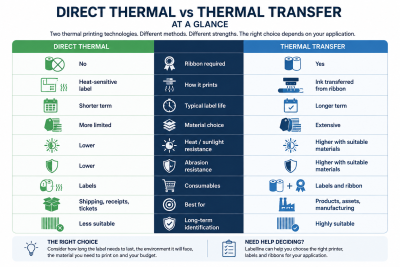
Direct thermal printers use specially manufactured heat-sensitive labels.
As the label passes beneath the printhead, heat activates the material and creates the required text, barcode or image. There is no ink, toner or ribbon involved.
This makes direct thermal printing simple and convenient, with fewer consumables to purchase and replace.
The downside is durability. Direct thermal material can be affected by prolonged exposure to heat, sunlight, friction and certain chemicals, causing the printed image to fade or the label itself to darken.
That's rarely a problem if the label only needs to last a few days or weeks.
Direct thermal is commonly used for:
Short-term stock and inventory labels
A parcel label, for example, might only need to remain readable while the package travels from a warehouse to its destination. Direct thermal is ideally suited to that type of application.
Once you understand what you need your label printer for, you can start looking around for the best model. These range from basic machines that print labels, but don’t do much else, to specialist printers that are designed for your work/industry.
Thermal transfer printing uses a ribbon positioned between the printhead and label.
Heat from the printhead transfers ink from the ribbon onto the label surface. This allows thermal transfer printers to work with a much wider range of materials and produce considerably more durable labels.
Thermal transfer is commonly used for:
Where a label needs to remain readable for months or years, thermal transfer will generally be the better option.
If you rely on your portable printer(s) for work, you need to make sure it’s taken care of. You can improve the lifespan of a printer with some basic cleaning and maintenance, clearing out jams and cleaning the print head between uses.
The biggest advantage is simplicity.
There's no ribbon to purchase, store or replace, which means fewer consumables and quicker label changes.
For businesses printing large volumes of short-life labels, there's little benefit in producing something designed to survive for years.
Its main limitation is the same thing that makes the technology work: the label remains sensitive to environmental conditions after it has been printed.
If long-term durability matters, direct thermal probably isn't the right choice.
The main advantage of thermal transfer is durability.
By choosing the appropriate combination of ribbon and label material, labels can be produced that withstand moisture, abrasion, temperature changes and exposure to chemicals.
There is also a much greater choice of label materials.
The trade-off is that thermal transfer requires ribbons as an additional consumable and choosing the right combination of ribbon and label is important.
It really comes down to the job the label needs to do.
Choose direct thermal if you're producing short-life labels, want straightforward operation and don't need significant resistance to heat, sunlight or abrasion.
Choose thermal transfer if labels need to remain readable for longer, will encounter more demanding conditions or require specialist label materials.
If you're still unsure, consider these three questions:
Answer those and the choice between direct thermal and thermal transfer will often become much clearer.
Labelline supplies and supports commercial thermal printers and can advise on the right printing technology, labels and ribbons for your particular application. If you're unsure which setup you need, speak to the Labelline team before investing in new equipment.
Unit 10 Webber Estates
Webber Road
Liverpool
L33 7SQ